
Election Defeats Are Not New to DMK…
Though DMK has enjoyed a continuous streak of victories since 2019, this particular defeat feels significantly more painful.
Another actor has emerged as a leader, following the footsteps of MGR and NTR. Let us congratulate him… Congratulations!
For the past 24 hours, various media outlets, WhatsApp groups, and tea coffee-shop benches have been incessantly debating how he won, how DMK lost, and how ADMK pushed to the third spot. Many opinions are being voiced, claiming “this went wrong” or “that was the mistake.”
Here was a leader who consistently moved Tamil Nadu toward double-digit economic growth for two years.
A Chief Minister who meticulously provided for youth, students, children, elders, and women—building new factories, bridges, road infrastructure, libraries, hospitals, educational institutions, working women’s hostels, and creative hubs across the state.
A great man who showered the people with welfare schemes like *Naan Mudhalvan, Pudhumai Penn,* Magalir Urimai Thogai (Women’s Basic Income), free bus travel, and the breakfast scheme.
And yet, some beat their chests, claiming they have toppled such a man. If you look at who defeated him, it is the very people for whom he worked beyond his capacity.
It is the people of his own Kolathur constituency, where he has won consistently before.
If one visits Kolathur, they can understand the thousands of crores spent on facilities there. With AC bus stands, brand-new housing complexes, state-of-the-art hospitals, libraries, schools, Metro rail, and superior roads, Kolathur looks as beautiful as—or even a step above—South Chennai.
Did the people receive all these benefits and still defeat their proud Chief Ministerial candidate?
Yes, that is the truth.
One is left without an answer to the fundamental question:
How should one work in politics? Even those who do nothing win easily, while someone is defeated after achieving so much.
But… why the surprise?
Humans have lived this way for ages. If not, would Valluvar have written so many couplets on gratitude?
> *”Ennandri Kondraarkkum…”* (For those who kill any virtue…)
> *”Nandri Marappadhu…”* (Forgetting gratitude…)
>
Let’s look at the last one:
**”Udhavi Varaithandru Udhavi Udhavi Seyappattaar Saalbin Varaithu.”**
*(The value of a benefit is not in the measure of the gift; it is in the worth of the recipient.)*
Some might argue, “A ruler only did his duty; why talk as if it’s a grand achievement?”
Many rulers have come and gone on this soil.
Five years ago, Edappadi Palaniswami ruled;
before that, Jayalalithaa ruled for six years.
Can anyone point out how many schemes, how much infrastructure, or what specific growth was achieved in those ten years?
Does anyone even remember?
Can anyone point to any other state in India that has seen achievements comparable to the DMK government?
Some even ask, “Did they do it with their own money?”
True, no one can run a government with personal funds.
If they did, it wouldn’t be a government.
No government in the world runs on the ruler’s private wealth.
A good administration is about spending public money correctly to fulfill the people’s needs.
However, only under the DMK regime were plans and infrastructure created keeping both current needs and future benefits in mind.
A thousand examples could be cited.
People babble about “corruption.” No one is justifying corruption here; it must be stopped.
But we face much larger issues in society daily. Between a pickpocket and a murderer, whom do you catch and punish first?
Furthermore, corruption and bribery exist in every government worldwide. Actions depend on the scale and how much it affects the people.
While we blame the government for being corrupt, we don’t think about the “corruption” among the people.
One could say if the government is right, the people will be right; or, if the people are right, the government will be right.
Both are valid.
But it cannot be denied that corruption exists in both.
Therefore, the people’s blame on the government alone is unacceptable.
The government works to create opportunities for people to educate their children, find jobs, live a good life, and provide rescue during disasters.
If there is a lapse or stagnation there, they should be questioned. In these five years, there was no such environment to question the DMK government.
Barring four or five law-and-order issues like certain crimes, honor killings, or illicit liquor deaths, nothing else went wrong.
Even those were handled correctly, and justice was delivered in several cases. Even for crimes committed during the previous regime, this government ensured justice and punishment for the culprits.
Thus, there was no major grievance against this regime.
But, as the saying goes, *”If the daughter-in-law is disliked, even her touch is a mistake,”*
even small issues were blown out of proportion.
An illusion was created that no action was taken and that Tamil Nadu was “ruined.”
A narrative was spun that a “Messenger of God” was needed to rescue the state.
This story was injected into the minds of innocent people and Gen-Z youth via social media, stopping them from thinking and securing this victory.
While traditional parties like DMK and ADMK—who don’t rely heavily on the internet—were busy meeting people and conducting rallies, the newcomers entered people’s pockets via mobile phones.
Through lies and fabrications, they sat inside people’s brains and completely altered the election results.
Managing the administration won’t be very difficult for the new government because DMK has streamlined all departments.
Regardless of who is in power, this administrative structure will run on “autopilot” for a while.
However, without proper monitoring, the people will face terrible consequences.
But none of this will be visible outside, because the same social media will spread the same kinds of lies and deceive the people again.
Consequently, people may not worry or rise up against the new regime, no matter how it performs. It is unclear how long this will continue.
Above all, a crucial question remains: Why did the people who showered so many votes not give this new party a thumping majority?
DMK has actually secured more than its 30% core vote bank. The difference between the winning party and the second-placed DMK is only a few lakh votes.
In the 2016 election, the difference was about one lakh; this time, it has increased slightly.
This shows that about 15% of the people who trusted DMK in the last three elections shifted to the new party this time.
DMK’s fundamental vote bank has not split. The DMK cadre remains with the party despite any storm. Let the party remember this.
**So, what “mistake” did the DMK government make?**
DMK made only one mistake: when 41 people were crushed to death (in a past incident/context), the party failed to arrest and investigate the party leader and his associates who stood there singing songs.
The fact that there was no “sub-king” to question or a “guard” to imprison a “Great King” who campaigned calling this a “Monarchy” shocked not just party workers but the general public.
Even after knowing a famous actor had become a party leader and was campaigning against them, no top leader directly opposed him or countered his speeches. Everyone failed to notice that his teeth-gritting, eye-bulging, cheek-shivering speeches were perceived by the people as a “top-tier cinematic performance.”
No one from the DMK side asked: “You accuse us, but tell us exactly what crime we committed?”
No one asked: “You insult us, but what is your standard? How did you enter cinema?
Didn’t your family live off Kalaignar s patronage during MGR’s rule? Who inaugurated the marriage hall you built?
How did you get the title ‘Ilaya Thalapathy’?
Shall I tell the world about the corruption in your own industry?”
No one explained on the campaign stages the fundamental difference between a Monarchy and a Democracy to those calling democracy a “Monarchy.”
No one asked the question: “How would you have entered cinema without your father?”
While some neutral media, individual journalists, people like me, and third-tier leaders spoke about these things, the silence of the big leaders created a “vacant playground” for that actor and his party.
Lastly, no neutral media, intelligence agencies, or strategists predicted or stated before the election how massive this actor’s influence would become.
Perhaps, if timely rebuttals had been given, this influence wouldn’t have grown—that is another perspective.
Despite a thousand achievements and efforts to take them to the people, they didn’t reach. But the lies spread by the new party reached the people with ease.
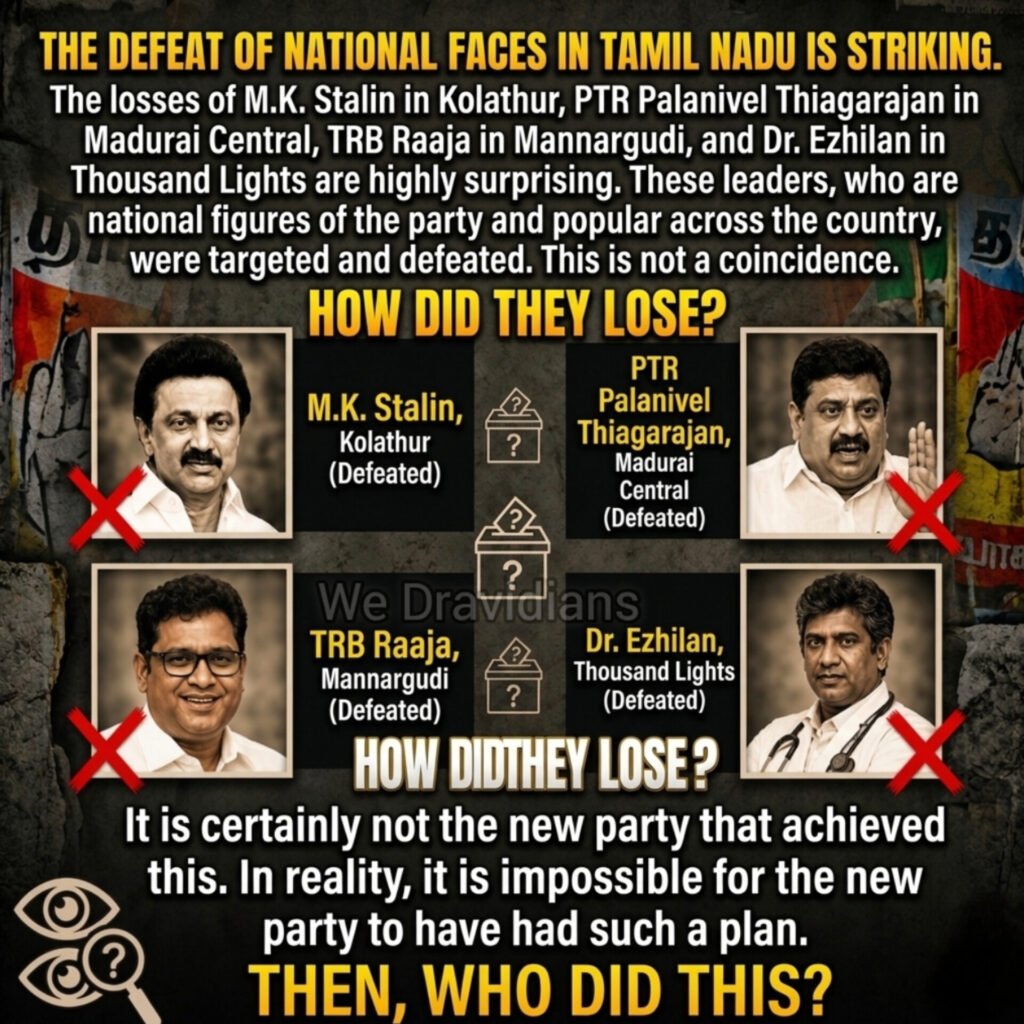
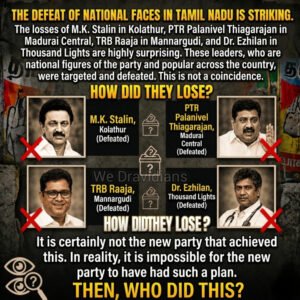
Beyond this, another important point: The targeted defeats of national faces like the CM in Kolathur,
PTR Palanivel Thiagarajan in Madurai Central,
TRB Rajaa in Mannargudi, and
Dr. Ezhilan in Thousand Lights suggest a calculated move.
It is unlikely that the new party alone had such a grand plan. Then who did it? We must think and speculate.
**What do you think will happen in the new regime?**
Don’t you know? From now on, rivers of honey and milk will flow in Tamil Nadu, and everyone will drink their fill.
Congratulations once again to everyone.
Long live Tamil Nadu!
Long live India!
Kathir RS
5/5/26

More Stories
Corruption is a Problem. But is it the Biggest One? – Kathir RS
Lies will Triumph! Only Lies will…! – Kathir RS
Karur Stampede: TVK’s Post-Tragedy Controversies Exposed